
GEORGE WASHINGTON SPEAKS BLOG ARTICLES
OUR ARTICLES ARE CURRENT SO CHECK BACK AND KEEP UP ON OUR EVENTS AND NEWEST VIDEOS.
SULGRAVE MANOR VISIT
Sulgrave Manor, Historic Home and Monument to Peace
This July, I visited Sulgrave Manor in England, the ancestral home of George Washington’s family. The historic house and grounds are well-maintained, and knowledgeable guides shared the property’s history. The home is furnished with many period pieces and reproductions. The gardens also contain heritage varieties of plants and fruit trees.

The property is supported by both English and American sources, and was purchased in 1914 as part of a project to commemorate 100 years of peace between the United States and England, since the Treaty of Ghent in 1814 brought a formal end to the War of 1812. Despite a struggle for many years with limited funding, the property is currently kept in very good condition.
Additional buildings provide venue rental space and an exhibit about George Washington, which includes several personal items of Washington’s that have been donated. The exhibit highlights many aspects of Washington’s life that are presented by George Washington Speaks, for example myths about Washington, the influence of his wife, Martha, and the influence he had as a military leader, statesman, and finally as president of the new country.

George Washington’s Roots
In the pastoral countryside of Northamptonshire, England, Sulgrave Manor was built in the 1500s by George Washington’s distant ancestor, Lawrence Washington—a name frequently repeated in the Washington family records.
Lawrence Washington prospered as a wool merchant, and enhanced his prosperity through successive marriages to two wealthy widows. Another source of Lawrence’s wealth in the mid-1500s came because he was a Royalist supporter of Henry VIII. With the king’s dissolution of monasteries after breaking with the Roman Catholic Church, Lawrence was able to purchase properties he had held as a tenant of a priory in Northampton which was seized by the Crown.
FUN FACT: George Washington also married a wealthy widow—Martha was said to be the wealthiest widow in Virginia at the time.
Robert Washington, eldest son of Lawrence, inherited Sulgrave Manor and continued to prosper in land dealings, favorable marriages, and political connections. The family was well-established in the gentry of England, and Robert married twice.
FUN FACT: Robert’s nephew, Sir Lawrence Washington, owned Stonehenge for about fifty years in the 17th century.
Lawrence Washington, Robert’s eldest son (born c. 1568) sold Sulgrave in 1610, during his father’s lifetime. Through his marriage to Margaret Butler, Lawrence’s descendants gained the right to use the Plantagenet coat of arms on their shield. The family was closely tied to the Spencers, the Villiers, and other families with royal connections. As the English Civil War approached (1642-1651), the Washingtons remained Royalists.
FUN FACT: The late Princess Diana was a distant cousin of George Washington through the connection with the Spencer family, centuries before either was born.
The Reverend Lawrence Washington, fifth son of Lawrence and Margaret, was born at Sulgrave in 1602, and was educated at prestigious Oxford University. As a churchman, he supported the royal interest in ridding Oxford of Puritans, ingratiating himself to the Crown. In 1633 he gained a prosperous position as rector of a parish in Essex, and married an heiress the same year. But when Parliament gained control of the government from the Royalists, he was ejected from his prominent parish and given a poor living in Essex. Unable to support his wife and now seven children, Lawrence sent them to live with her stepfather, and he died in poverty in 1652.
FOOD FOR THOUGHT: His active support of the Crown cost Rev. Lawrence Washington his position and income. What if George Washington had remained a Loyalist to the king 150 years later?
John Washington, the Reverend’s eldest son, and his brother Lawrence, eventually received an inheritance from a godparent and distant relations, and with that money they pursued opportunities in trade together. In 1657, John Washington traveled to Virginia, filled a ship with tobacco along the Potomac River, and prepared to return to England. A storm came up and the ship ran aground on a shoal in the Potomac near Mattox Creek. The cargo was ruined, and the ship needed repairs that took some time. Washington made the history-changing decision to remain in the Virginia Colony, and the following year, married Anne Pope, daughter of a planter. Upon their marriage, her father gifted them 700 acres of land at Mattox Creek, the beginnings of landholdings that would exceed 6,000 acres in his lifetime. John and his brother Lawrence continued to build their trading business together, John in Virginia and Lawrence in England.
FUN FACT: Among John’s 6,000 acres was some of the property that would become the Mount Vernon estate.
Lawrence Washington, John’s eldest son, was born at Mattox Creek in 1659. When his father, John, died in 1677, Lawrence inherited most of his estate. He married into the prominent Warner family, and had three children. Lawrence died at about age 30, leaving his wife Mildred with three young children, including second son Augustine, age three. Mildred soon married George Gale, a trading partner of her late husband, and returned to England with the three young children. Mildred died soon after moving to England, and when George Gale returned to Virginia on another trade mission, he was challenged in court for the children’s custody by a cousin of his step-children’s father Lawrence. In 1705 the three children were returned to Virginia to the care of their late father’s cousin.
FOOD FOR THOUGHT: George Washington’s American upbringing might never have happened if the custody battle for his father Augustine as a young child had favored his step-father rather than his distant cousin.
Augustine Washington, Lawrence’s second son, came of age in 1715, and at that time gained his inheritance of 1700 acres. He married Jane Butler, and they had four children, although only two—Lawrence and Augustine—survived to adulthood. After his wife Jane’s death, he married Mary Ball in 1730, and their first child, George, was born in 1732. They had several more children in rapid succession, until, in 1743, Augustine Washington died. His older sons were educated in England at Appleby’s School, and George had looked forward to an education there himself. But with his father’s untimely death, everything changed.

George Washington became the ‘man of the house’ at age 11, when his father died, and his mother did not remarry. They lived in poverty on Ferry Farm near Fredericksburg, Virginia, where George had little opportunity for social or economic advancement.
Although George Washington’s papers do not reveal that he had an interest in his family history, I found the visit to Sulgrave Manor thought provoking, considering the long history of the family’s Royalist views and their connections with aristocratic families. As tensions built between the colonies and England, Washington remained loyal to England until about 1774, hoping that a diplomatic solution to their differences could be found. But when he realized that England would not give any ground, Washington devoted himself fully to the cause of America’s freedom.
Nationwide celebrations lead to July 4, 2026
Parades, marching bands, burgers on the grill, and dazzling fireworks in the evening skies. Sounds like Independence Day, right? Don’t forget the potato salad and watermelon!
We may celebrate the event every year, but July 4 of 2026 will herald the 250th anniversary of our nation’s Declaration of Independence, a monumental milestone.
A Celebration in Every State
It’s America’s birthday, and plans are underway throughout the country to mark the occasion.
America250.org is the official ‘party planner’ with a nationwide initiative to honor the past, celebrate the present, and inspire the future. Here are a few of their current projects—with more to come!
-
America’s Field Trip engages schoolchildren through a multi-year art and essay contest, exploring the meaning of America.
-
Our American Story is an oral history project inviting all of us to document our own understanding of the United States.
-
America Gives challenges businesses, non-profits, schools, youth groups, faith-based networks, and organizations of all kinds to commit to increasing their level of volunteering and impact starting on Jan 1, 2026.
-
State level America250 groups are working throughout the nation to plan events and encourage counties and local communities to find ways to celebrate. Links on their website will take you to state and local partners.
How Are We Involved?
George Washington Speaks has seen a marked rise in requests for personal visits as well as a strong growth in interest on social media. We are eager to participate in the new events being planned at the state and regional level. In addition to the classroom and civic group presentations we often make, we are already planning for and scheduling fairs, parades, history-related public events, and sporting events. With years of experience in sharing America’s 18th century history, we look forward to collaborating with other groups to celebrate next year’s benchmark birthday.
How You Can Get Involved
Are you making plans to celebrate in a big way?
America250 is designed to be an inclusive celebration, inviting all Americans to take part in honoring the nation’s history. Here’s how you can get involved:
-
Attend local events – Many cities and states are organizing their own America250 celebrations.
-
Explore exhibitions – Visit museums and galleries featuring special installations related to the anniversary.
-
Share your story – America250 encourages individuals to reflect on their personal connections to American history and contribute to the national conversation.
-
Volunteer or donate – Support initiatives that promote historical education and community engagement.
Looking Ahead
As America approaches its 250th birthday, this celebration offers a unique opportunity to reflect on the nation’s journey, acknowledge its challenges, and envision a future built on unity, innovation, and progress. Whether through historical exhibitions, patriotic tributes, or community-driven events, America250 is set to be a defining moment in the country’s history.
For more details on upcoming events and ways to participate, visit the official America250 website.
Let’s honor the past, celebrate the present, and inspire the future—together.
Click to learn more about George Washington Speaks.
SURROUNDED BY PATRIOTS
George Washington didn’t live in a vacuum, and I cannot develop a clear picture of his life and times without learning something about the people around him. These include other colonial and national leaders as well as the men who served in the Continental Army, sharing the fight for freedom that Washington led.
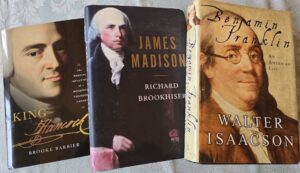
Some are household names in America, like John Hancock, famous for his bold signature on the Declaration of Independence. He is the subject of a 2023 biography by Brooke Barbier, titled King Hancock: The Radical Influence of a Moderate Founding Father.
Hancock and Washington were close in age, but grew up in vastly different circumstances—except for one. Both men lost their fathers at a young age. I look forward to delving into the details of Hancock’s life, and how he came to the Patriot cause.
Ben Franklin was a generation older than Washington and Hancock, and grew to prominence in Philadelphia as a newspaper editor and printer. But he had his hand in many pots, and Walter Isaacson’s biography, Benjamin Franklin: An American Life, reveals much about his interests in science, government, and international affairs.
James Madison was nineteen years younger than Washington, part of a generation who would carry the country through another war—with Madison as president this time. Richard Brookhiser’s biography James Madison fills in the details, from a young Madison’s admiration for Washington to his own service at the highest level.